Renovation planning
Pond renovation: repair, retrofit or rebuild?
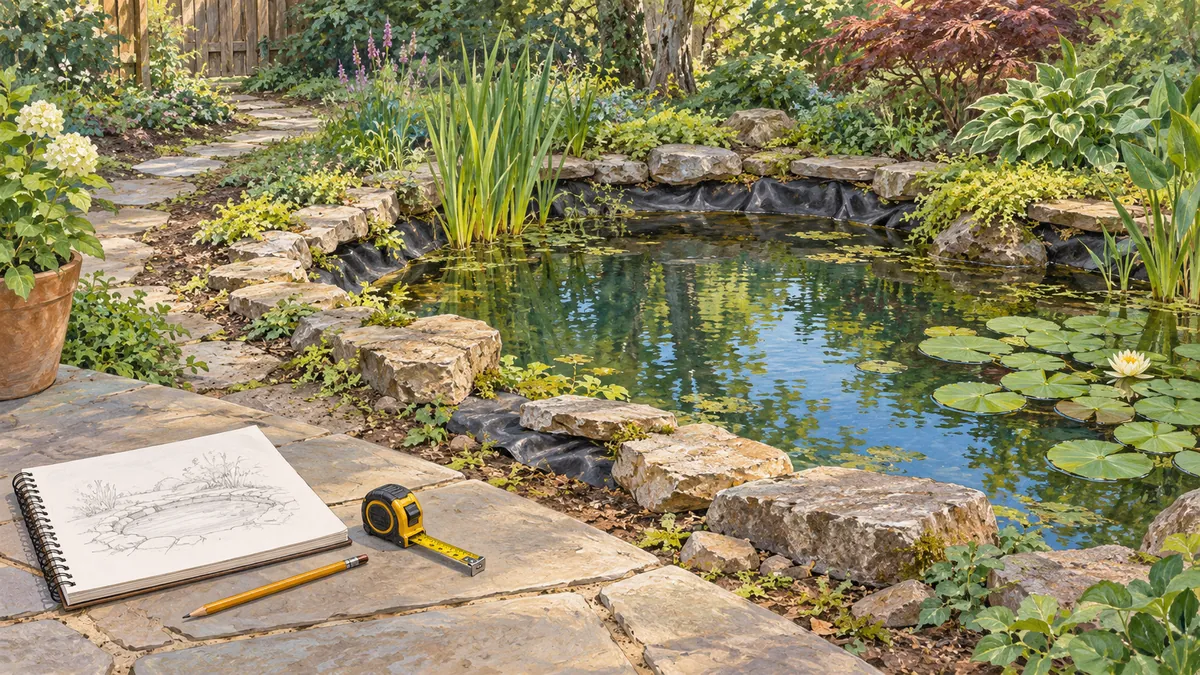
Keep the parts you can show are sound, repair or retrofit faults that stay local, and rebuild when the problems are shared across the liner, circulation and access. Make that call from a written condition inventory, and state the unknowns before any price. Buried work, demolition and fish care are the lines most likely to change a quote once work starts.
Record the existing pond first
Walk the pond and write down each system as found, with photos and tape measurements. If you want a scale layout, enter the measured dimensions and depths in Studio or the app. Studio draws the geometry you enter. It does not reconstruct a pond from a photo.
| Item | Record | Why it matters |
|---|---|---|
| Liner and edges | Visible folds, damage, what is built over or against it, where edges are wet or dry | Reuse is a judgment after inspection and a material compatibility check, not an assumption |
| Waterfall and stream | Where water leaves the course, what stone and foam sit on top | Access to a fault may require taking the feature apart |
| Circulation | Pump, plumbing, skimmer or filter, and whether each runs normally | Working equipment may stay in scope |
| Bottom | Muck, rock, anything buried | Buried conditions are the hardest to price in advance |
| Access | Route in, lawn or hardscape to protect, where debris can be staged | Drives demolition labor and disposal |
| Fish and plants | What lives in it, and where it can be held | Creates a separate holding line |
Separate cosmetic changes from system faults
A cosmetic change adds or alters features. A system fault is water loss, failed circulation or a failing liner. They need different scopes, and mixing them inflates a repair quote.
One TEAM Aquascape video covers a mature pond with a waterfall the team judged good. They suggested adding an urn and a spillway bowl instead of rebuilding it (video). That was a decision about a sound waterfall. If your waterfall is the part that loses water, it does not apply. Confirm where the loss is first, using the leak and evaporation guide.
Three scopes for an illustrative leaking waterfall
Assume the pond equipment runs normally, the waterfall loses water, and the loss location is not yet confirmed. Every price cell below is a placeholder to fill from local quotes.
| Scope | Work | Keeps | Main unknown | Price lines |
|---|---|---|---|---|
| A. Repair | Confirm the loss point, open that area, fix it, refill | Basin, equipment, most of the waterfall | A second fault, or liner condition under the stone | Diagnosis [P1], repair labor [P2], materials [P3], refill and water treatment [P4] |
| B. Retrofit | Take the waterfall and stream apart, rebuild the course with new lining, reconnect to existing plumbing | Basin and equipment | Whether the old basin liner can be joined to new material | Dismantling [P5], new lining [P6], stone reset [P7], disposal [P8], A's refill line [P4] |
| C. Full rebuild | Demolish, haul away, rebuild basin and waterfall | Possibly equipment, if it checks out | Buried work, debris quantity, fish holding time | Demolition [P9], disposal [P8], all new construction [P10], fish holding [P11] |
Write A with a change trigger. If opening the area shows damage beyond the scoped patch, the job moves to B and gets repriced. Total each scope as its fixed lines plus a stated allowance for unknowns, and show the allowance as its own line so the owner sees it. Use actual local estimates for P1 to P11, not figures from another region or project.
Budget demolition, disposal and fish holding
Demolition and disposal
In one pondless rebuild that replaced an old pond, TEAM Aquascape named demolition and removal as the hardest part. The advice was to price tear-out labor and debris disposal into the estimate (video). List the debris you expect: stone, sod, old liner and old components. Then price a disposal route, such as a dump site, a dumpster or storage at your shop.
Muck and buried conditions
In another TEAM Aquascape video, an old pond with about 25 years of muck was cleaned out and reshaped slightly. The area was then checked for a buried box before fabric and liner went in (video). That is one project's plan. For your pond, list buried work as an allowance or an exclusion until it is exposed.
Holding fish
In one rebuild, TEAM Aquascape held fish in a tub with an air stone and pump, expecting them out about eight hours. That time was specific to that job (video). Your holding time depends on your scope, so estimate it from your own schedule.
Municipal water can contain chlorine or chloramine, which harm fish and filter bacteria (Merck Veterinary Manual). Replacement water needs a treatment matched to both. This article gives no dose or holding duration. Follow the product label, and ask an aquatic veterinarian or extension office about your fish.
Price holding as its own line: tub, aeration, treated water, someone to watch the fish, and transport if needed.
Write the exclusions and inspection triggers
Exclusions state what the price does not cover. Triggers state what makes work stop for a repricing conversation.
- Exclude liner condition outside the exposed area.
- Exclude buried structures, utilities or debris found during digging, unless an allowance is written.
- Name who handles fish care, lawn repair and hardscape restoration, and state what each scope includes.
- Cap disposal at a stated quantity, and price anything above it.
- Trigger: damage or a second leak found beyond the scoped area. Stop, photograph, reprice.
- Trigger: reused equipment fails once the system runs. Record it and quote the replacement.
- Trigger: the liner proves incompatible with the materials being joined to it.
Sequence for the decision
- Complete the inventory table with photos and measurements.
- Locate the fault before choosing a scope.
- Write scopes A, B and C with the price lines above.
- Collect local quotes for each line and fill the placeholders.
- Add exclusions, the unknown allowance and the triggers to each scope.
- Plan fish holding, water treatment and a return plan before demolition starts.
- Choose the scope whose unknowns the owner accepts, not simply the lowest total.
For quantities, enter your measured figures in the liner and volume calculators. Use the pump calculator to check existing equipment against a changed waterfall. These return results from the numbers you provide, so inspect the site as well.
Sources
- Providing a Home for Fish, Merck Veterinary Manual
- Pondless STREAM & WATERFALL Replaces Old Pond (TEAM Aquascape)
- Family POND Transformation! - In Loving Memory FINAL (TEAM Aquascape)
- We Install a WATERFALL with Just Two Guys! (TEAM Aquascape)
- The Pond Guy Gives Fowl Mouth Farm A New Pond! (TEAM Aquascape)