Rock placement
The 1:2:1 rock rule is copying a real curve
Aquascape tells its contractors to buy pond rock in a 1:2:1 ratio: one part small, two parts medium, one part large, measured by the ton. It is a good rule. What nobody says out loud is why it works, and the answer is that the rule is a three-bar sketch of a curve that shows up on every river bank and scree slope on Earth. Once you see the curve, you can lay rock to it instead of to the rule, and the difference shows.
The rule, as written
The version in Aquascape's contractor article Choosing the Right Rocks for Your Water Feature is one line: "A good rule of thumb is to use the 1:2:1 ratio. 1 part small rock, 2 parts medium rock, and 1 part large rock." The parts are tons. Aquascape Australia's rock guidelines put sizes on the bins: for every tonne of 15 to 30 cm rock, two tonnes of 30 to 45 cm and one tonne of 45 to 60 cm. In inches that is roughly 6 to 12, 12 to 18 and 18 to 24. The stated reason is scale, that big stones only look big next to small ones, and that this is "the most natural look for a pond or waterfall."
Count the stones instead of weighing them
Weight hides what the rule really asks for. Two rocks of the same stone and the same general shape differ in weight by the cube of their size, so an 18-inch rock weighs about eight times what a 9-inch rock does. Run the ratio through that. One ton of 6-to-12-inch stone, two tons of 12-to-18 and one ton of 18-to-24, averaged across each bin, comes out to about 65 percent small stones, 30 percent medium and 5 percent large, by count. Put another way, for every large rock you set, you are setting five or six medium ones and about twelve small ones.
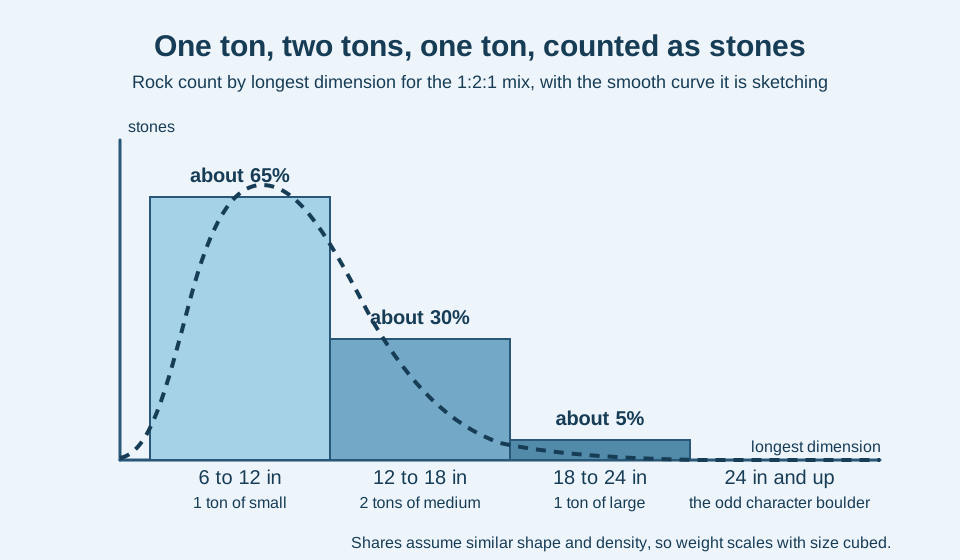
The split is a long way from even. The count drops steeply from many small stones to a handful of large ones, and that shape has a name. A log-normal curve with a median around 10 inches and a geometric spread of roughly 1.5 puts almost exactly those shares in those three bins. It also puts a few percent of stones above 24 inches and a good number below 6, which is where the character boulder and the cobble come in. The rule is a histogram of that curve drawn with three bars.
What a real bank looks like
River scientists have been measuring this curve since 1954, when M. Gordon Wolman published a method of sampling coarse river-bed material: walk a gravel bar, pick up the stone under your toe every step, measure it, repeat a hundred times. The Wolman pebble count is still the standard field method, and the U.S. Forest Service manual by Bunte and Abt, Sampling surface and subsurface particle-size distributions in wadable gravel- and cobble-bed streams, is a free manual of over 400 pages on how to do it and what the results look like. What they look like, plotted on a log scale, is a hump with a long tail toward the big sizes: most of the stones are small, the count falls off steadily as size grows, and there is a hard ceiling above which nothing is found.
Which curve fits best is still argued. The log-normal is the classic choice. In 2025 Vázquez-Tarrío and Recking re-analysed 462 grain-size distributions from gravel-bed rivers against five candidate shapes and found that the Weibull distribution, along with Recking's own empirical model, fit best. Weibull is the shape you get from rock breaking repeatedly. Brown and Wohletz showed in 1995 that sequential fragmentation produces a Weibull distribution, and that the same distribution written in terms of mass looks almost exactly log-normal. So the disagreement is only about which skewed curve fits best. Every candidate says the same thing: there are many small stones, fewer medium ones, very few large ones, and the sizes stop at a ceiling.
Where the ceiling comes from is the useful part for a builder. Sklar and colleagues framed the size of sediment that hillslopes deliver to rivers as an unsolved problem, and the follow-up field work by Verdian and others found that the size of rock on a talus slope tracks the fracture spacing in the cliff above it. The biggest stone a landscape can offer is set by how far apart the bedrock joints are. Below that cap, the curve tapers down the same way everywhere. That is why a natural bank never has three sizes of rock in equal numbers, and never has one giant that dwarfs the cap. The giants are rare, they are all roughly the same size, and they sit where they landed. Shobe and colleagues documented the same thing from the river's point of view: the biggest hillslope blocks stall in the channel and slow the river's cutting, so you find them at the base of the steep bits, not scattered evenly along the bank.
The same curve turns up off Earth. Counts of boulders around lunar craters and on asteroids fall off as power laws, and many of those fits sit near an exponent of three. Anything that breaks rock produces more small pieces than big ones, in about the same proportion, whether the breaking was done by frost, water or an impact.
Why the eye can tell
People do not know the curve, but they have looked at a great many banks and slopes, and they notice when a pond breaks the pattern. The two common ways to break it are equal numbers of each size, which reads as a rock garden, and a single boulder far larger than anything else, which reads as a monument. Both come from thinking in tons. A ton of each size sounds balanced. Counted as stones, it is a wall of small rock with a few large ones lost in it, and by count the 1:2:1 rule is already the fix.
Laying rock to the curve
Buy by the rule, because by weight the rule already is the curve. Then place by count. As you set stones, keep a rough tally, and expect to set about a dozen small stones and five or six medium ones for every large one. If the large pile is going down faster than that, you are building the monument.
Set a ceiling. Pick the largest size the design can carry, set two or three stones at that size, and let nothing exceed it. Those are the character boulders, and they belong where water would have left them: at the base of a waterfall, on the outside of a bend, at the toe of a slope. Rivers do not space them out evenly, so neither should you.
Extend the small end. The curve does not stop at 6 inches, it keeps climbing, so cobble and gravel are part of the same distribution rather than a separate decision. Aquascape covers the gravel and boulder tonnage in its stream rock guidance; the point here is that gravel between the small stones is what makes the small stones look like the tail of something rather than a border.
Cluster by size the way breakage and transport would. Stones of similar size tend to travel and stop together, so a run of mediums with small stones packed in the gaps looks right, and a medium stone alone in a field of gravel looks placed. If you want to check your own work, walk the finished edge doing a Wolman count, one stone per step, and see whether the tally drops off from small to large the way the figure above does.
Sources
- Aquascape, Choosing the Right Rocks for Your Water Feature, 2022, and Aquascape Australia, Rock and Pebble Guidelines.
- Wolman, M. G. (1954). A method of sampling coarse river-bed material. Transactions, American Geophysical Union 35(6), 951–956.
- Bunte, K. and Abt, S. R. (2001). Sampling surface and subsurface particle-size distributions in wadable gravel- and cobble-bed streams. USDA Forest Service RMRS-GTR-74.
- Vázquez-Tarrío, D. and Recking, A. (2025). The variability of grain size metrics in gravel-bed rivers. Catena 255, 108974.
- Brown, W. K. and Wohletz, K. H. (1995). Derivation of the Weibull distribution based on physical principles and its connection to the Rosin–Rammler and lognormal distributions. Journal of Applied Physics 78(4), 2758–2763.
- Sklar, L. S. et al. (2017). The problem of predicting the size distribution of sediment supplied by hillslopes to rivers. Geomorphology 277, 31–49.
- Verdian, J. P. et al. (2021). Sediment size on talus slopes correlates with fracture spacing on bedrock cliffs. Earth Surface Dynamics 9, 1073–1090.
- Shobe, C. M. et al. (2016). Hillslope-derived blocks retard river incision. Geophysical Research Letters 43.
- Purinton, B. and Bookhagen, B. (2021). Tracking downstream variability in large grain-size distributions in the south-central Andes. Journal of Geophysical Research: Earth Surface. Photo-based counts of tens of thousands of stones, cobble to boulder, along mountain rivers.
- Boulder counts off Earth: Abundance and size-frequency distributions of boulders in Linné crater's ejecta and The boulder population of asteroid 4 Vesta.