Waterfall troubleshooting
Why a pond waterfall is too loud or splashes too much
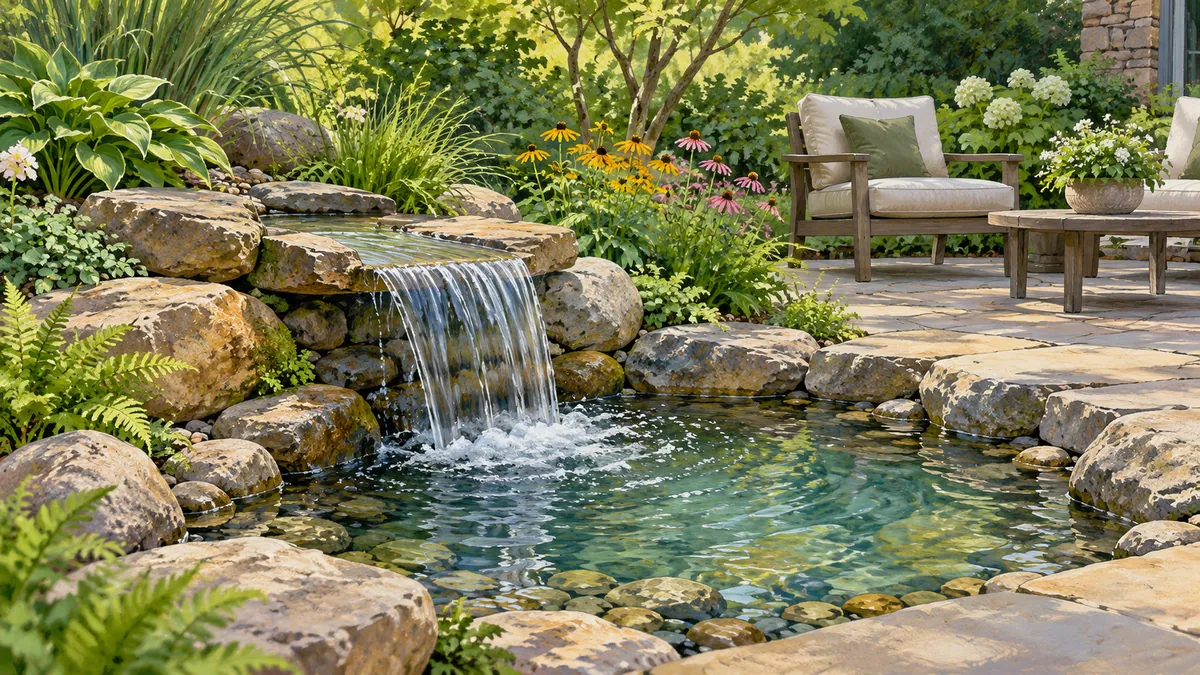
Check waterfall noise and splash loss separately. The drop, spill lip and landing surface affect sound; droplets that travel beyond the liner can cause water loss. Change one feature at a time and compare the result at your pond. There is no universal noise limit or splash distance for this worksheet.
Step 1: Name the complaint
Stand where people sit and run the waterfall for a few minutes. Then write down which of these applies:
- The sound is too sharp or too constant from the seating area.
- Water lands outside the pond edge on the liner, the soil or the patio.
- Both, or only on windy days.
Next, measure the drop with a tape from the lip to the surface it hits. Note whether the water lands on open water, on rock or on gravel. Those notes are the inputs for everything below.
Step 2: Check scale before anything else
A fall can simply be taller than the yard supports. In one TEAM Aquascape video about talking customers out of oversized features, the speaker describes a five-foot fall on a flat lot as out of scale, and a 24-inch fall as the natural-looking example. He adds that tall falls leak a lot when it is windy. He gives these as illustrations for one customer conversation, not as rules (TEAM Aquascape).
Use that as a prompt, not a limit. Compare your drop to the length of the yard and the size of the pond. If you are still planning, PondTools Studio lets you enter your own heights and dimensions and look at the geometry you created before digging. Aquascape's contractor article on excavation covers shelf planning, site levels and equipment access (Aquascape). Settling levels at that stage is cheaper than reshaping a finished fall.
Step 3: Work out flow per inch of lip
If the sound is the issue, check how much water passes over each inch of the spillway. This is original arithmetic with illustrative inputs. Use measured delivered flow at the waterfall, not the pump's maximum label rating.
| Case | Delivered flow (gal/hr) | Lip width (in) | Gal/hr per inch |
|---|---|---|---|
| A: current | 2,400 | 12 | 200 |
| B: wider lip | 2,400 | 24 | 100 |
| C: reduced flow | 1,800 | 12 | 150 |
Case A is 2,400 divided by 12. In gallons per minute, 2,400 gal/hr is 40 gal/min. The table only shows how a change moves the number. Whether case B or C sounds better on your pond has to be judged by ear. Reducing flow also changes how the stream and any filter or return downstream behave, so check those after a change. The pump calculator can help you compare flow against your head height.
Step 4: Try one change at a time
| What you notice | What to test | One change to try |
|---|---|---|
| Sharp sound at the point of impact | What the water lands on | Move or reshape the landing so water meets a different surface, then listen again |
| Sound changes when you shut off part of the flow | Flow per inch of lip | Widen the lip or lower the flow, using the worksheet above |
| Sound and splash both high | Drop height | Shorten the drop, or add an intermediate step in the fall |
| Splash only on windy days | Exposure and height | Lower the fall or add cover, then retest in similar wind |
| Wet ground beside the pond | Where droplets land | Check the liner catch area and its return slope; decorative edge treatment alone does not retain water |
These are tests, not guaranteed fixes. Record what you changed and what you heard or saw, so a second change does not hide the result of the first.
Step 5: Size the splash catch from observation
One TEAM Aquascape fountain install used a liner that extends well beyond the basin so splash rolls back in. The example had a gravel stream bed and a stacked slate feature, and the video gave no liner size. No product-specific splash envelope was supplied (TEAM Aquascape). So size it from your own test, not from that case.
- Run the waterfall on a day with the wind you want to plan for.
- Look for droplets or wet marks, and measure the farthest one from the basin or pond edge.
- Add a margin you choose.
- Use the measured reach and chosen margin as a candidate catch area to test. Any extension needs a compatible watertight connection and a return route to the basin.
Illustrative example: the farthest droplet lands 18 in past the edge, and you choose a 6 in margin. That is 18 + 6 = 24 in. On a basin 36 in wide with both sides affected, the liner width is 36 + 24 + 24 = 84 in. These inputs are made up for the arithmetic. For a full pond liner, use the liner calculator.
The catch liner must also slope so water returns to the basin, and the edge material needs to be secured so wind does not lift it. How you do that depends on the build. If you are not sure, ask the installer or manufacturer for the specifics of your product.
Step 6: Check water loss separately
Splash is one possible source of falling water level, not the only one. A level that drops while the waterfall runs does not by itself show splash is the cause. Keep a simple log of how much you add and when. An automatic top-off device only replaces the water and does not locate or stop a leak. If the log shows loss after you have caught the splash, look at the stream edges and the liner folds before changing more of the fall.
Checklist
- Write down the complaint: sound, splash or both.
- Record the drop height, the landing surface and the lip width.
- Compare the fall to the size of the yard and pond.
- Calculate flow per inch of lip for the current setup and one alternative.
- Change one variable and recheck from the seating area.
- Measure the splash zone, add your margin and test the catch area and its return route.
- Log top-off water for several days to separate splash from other loss.