Worked example
How big is a 3,000-gallon pond?
A rectangular pond measuring 16 feet long, 10 feet wide and 2.5 feet deep holds about 2,992 US gallons if it has vertical walls and a level floor. An irregular pond with shelves can need a larger footprint or a deeper floor to hold a similar amount.
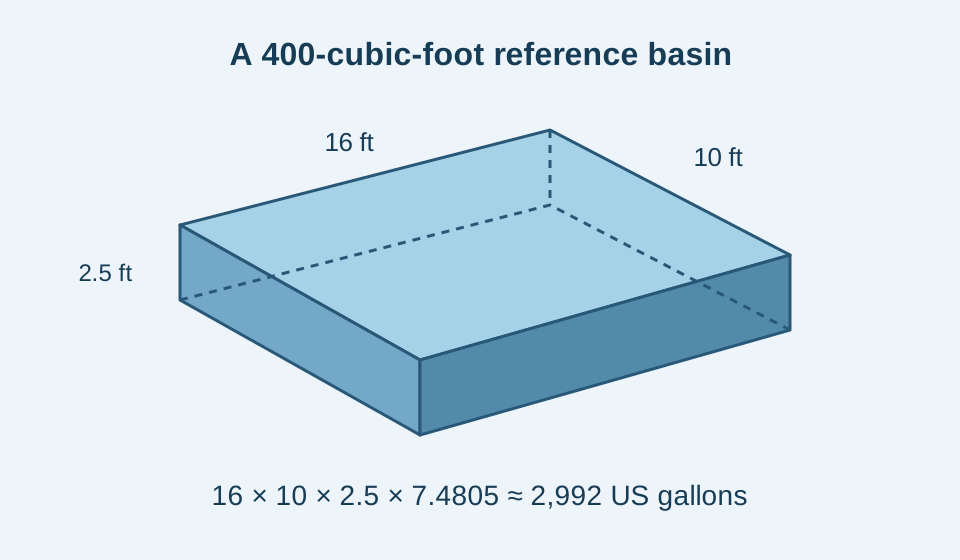
Start with the water volume
For a rectangular basin, multiply length by width by water depth. With measurements in feet, multiply the result by about 7.4805 to convert cubic feet to US gallons.
16 × 10 × 2.5 = 400 cubic feet ≈ 2,992 US gallons.
Here the depth is constant, so it is also the average depth. For an existing pond with an uneven bottom, use measurements that represent both shallow and deep areas. Penn State Extension explains how to estimate average depth and volume, including dividing an irregular pond into smaller areas.
Why the deepest point is not the average
Suppose that same 16-by-10-foot outline has a floor four feet below the waterline, but shelves occupy much of the basin. Multiplying the whole footprint by four feet counts every shelf as deep water. It also counts the corners outside an irregular waterline if you use only the longest length and width.
Draw the actual waterline and the boundaries between depth levels. The volume estimate can then account for how much area each level occupies. The shelf width, floor area and wall treatment all affect the result.
Compare an irregular example
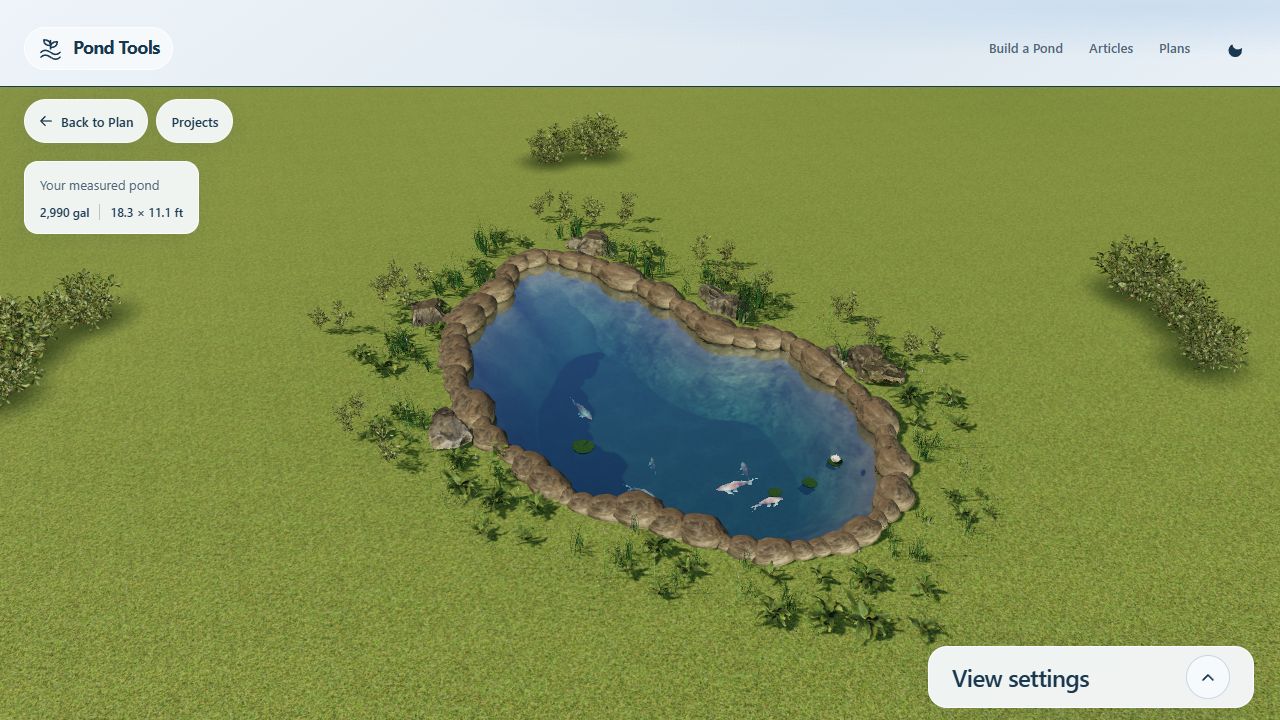
Our editable photo project has an irregular waterline, a layer at 18 inches and a floor at 48 inches, with sloped transitions. Its assigned scale produces these values:
| Waterline bounding span | 18.3 × 11.1 ft |
|---|---|
| Water surface area | 150.4 sq ft |
| Maximum depth | 48 in |
| Modeled volume | 2,990 US gal |
The bounding rectangle covers more ground than the waterline. Inside that waterline, the sloping sides and shallower layer reduce the volume further. This explains how a pond with a four-foot-deep floor can hold roughly the same water as our shallower rectangular reference.
Change one part of the plan at a time
Import the example into Pond Tools. Widen the shallow area while keeping the waterline fixed, then check the volume. Next, change the floor depth and compare again. This makes it easier to see which design choice is responsible for the difference.
Treat the result as a planning estimate. Rocks and equipment displace water, and the finished water level may differ from the drawing. Keep the plan updated as the pond is built; use actual measurements when accuracy matters. If you are buying liner, use maximum depth for liner sizing rather than the average depth used in a simple volume estimate.
Original diagram and product screenshot credits.